Ahem.
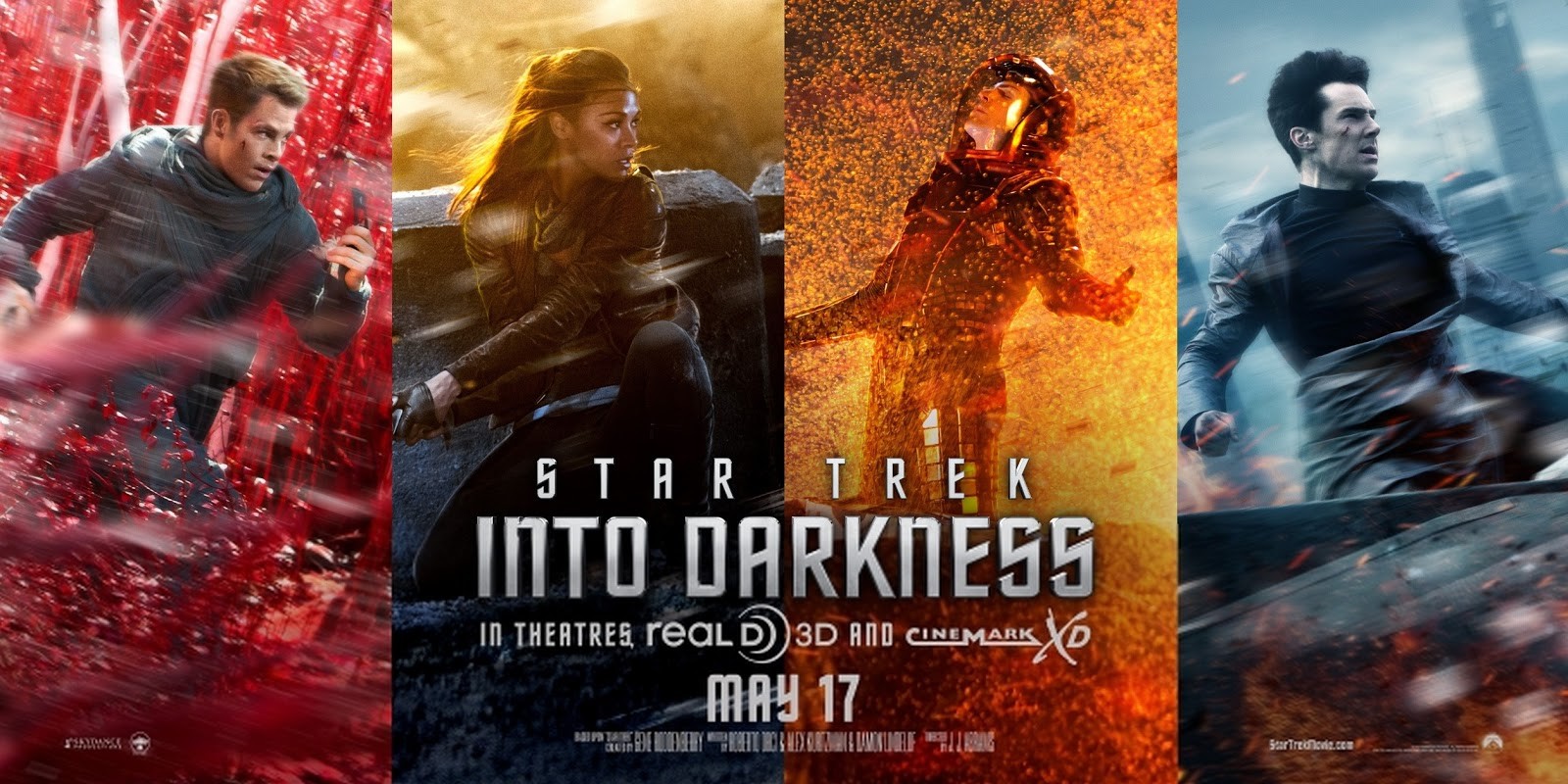
Like a good percentage of the world
I was super duper excited for Star Trek: Into Darkness (2013, Abrams). I
went to see it last weekend, a few days after its release, and all I had heard
about it in the interim was that it was incredible.
Originally I wasn't going to bother
writing a post about Star Trek as diving into the hornets’ nest of a
popular film based in an incredibly popular fandom is something I try to avoid,
but after a conversation I was barely involved in in the pub with two friends
who are long-time fans I decided whatever no-one's gonna read this anyway.
A point to make first: I am not a
Trekkie. I can see the attraction of the fandom and feel that if I sat down and
re-watched the series I probably would be, but as it currently stands I am in
no way intimately familiar with the Star Trek canon. It was one of those
shows I watched when I was younger, and enjoyed at the time, but have not seen
since. My biggest memory of it is my Dad teaching me how to do the Vulcan salute
(yeah I was cool as fuck) and little points of reference. So my memory of and
emotional connection to the series is patchy at best.
So here you have a Star Trek
post written by someone who will admit to perhaps not being the best person to
discuss the intricacies of the film's narrative canon and characterisation.
Bear that in mind. What I am discussing here is not how well the film worked as
part and parcel of the Star Trek series, what I'm concerned with, and
the reason why I think I didn't enjoy it as much as I had anticipated, is down
to the film itself, more specifically, it's down to how Abrams handled the
film.
During conversations I've had with
people about Into Darkness two points have been raised: that if you're
already engaged in the fandom you will either enjoy the film because it retains
enough points of reference (including direct fanservice) to recall that
original emotion, or you will hate it for the lack of imagination shown in just
recycling (and essentially perverting) plot points from previous films with a
little character switcharound (eg Quinto's re-enactment of Shatner's famous
line from Star Trek II: The Wrath of Khan (1985, Meyer).)
Let's watch it again, just for fun.
The main issue with the content of
the film stems from the emphasis on mindless action and the rehashing of famous
scenes from the original Trek films (specifically Wrath of Khan).
A cliché revenge/conspiracy film, there's a distinct lack of boldy going where
no one has gone before, which is after all, the heart of the Star Trek
storyline
"The biggest problem comes
with the revelation of the worst kept secret of the film. That “John
Harrison” is in fact Khan and that the 3rd act is Abrams and Co. doing cover
versions of Wrath of Khan scenes. So that instead of Spock sacrificing
himself to save the crew by going into the radiation chamber and Kirk yelling
“Khaaaannn”, it’s the other way around. It is fan service at its
worst. They are undeserved emotionally and are pandering imitations,
compounded by an unnecessary final action scene and a deus ex machina that they
already had at their disposal. And the fact that it ends with Khan and
his supermen back in the cryo tubes means that they can trot him back out
whenever they feel like it, which is the last thing they need at this point."
- Annand (2013)
But the problem with Into
Darkness is not just necessarily its content, it's the form. A friend of
mine who came to a similar conclusion (and is also writing his own post on this
which will probably make mine look even more like drunken ramblings) described
it as "a film about personal connections and sacrifice where the audience
can't connect". This is the crux of the problem. At the big heart-string
pulling scenes (you know the ones) I found myself sitting wondering why I was
not welling up. I'm a bit of a sap when it comes to connecting with films, I
cry at the drop of a hat but here small things kept me from that strong
emotional connection with the characters: continuity errors, suspect acting,
cliché dialogue and Abrams' ever intrusive cinematic form.
Undoubtedly Into Darkness can
be classed as a mainstream film. Despite the sci-fi genre it contains a
baseline of classical Hollywood form, the narrative emphasis placed upon the
psychological motivations of the characters. These are well-established
throughout, the film is based in emotion and the focus is on the human
characters. Though the aspect of romance is underplayed it is still present,
though perhaps most notably through the unstable 'bromance' between Kirk and
Spock. The characters are goal orientated, driven by psychological desires
(emotion: pride, duty, love) and the main drivers of the narrative are the central
male characters.
This type of film requires the
emotional/intellectual immersions of the audience within the world of the text
in order for it to work on any kind of significant, emotive level. But here we
are all too aware of the barrier between spectator and subject. The Hollywood
form is based upon a discourse of invisible style and continuity editing: the
camera functions as the invisible, unobtrusive eye of the viewer which is
designed not to draw attention to itself. In my opinion Abrams succeeds only in
distancing us from the connecting with the bonds which form the crux of the
narrative themes. This was a film with an incredible amount of heart, but the
viewer could not feel it and so could not connect with the characters. We are
firmly and constantly reminded of our position as spectators upon a screen.
Firstly, those bloody lens flares.
Now this has been said so many times already that it's become a cliché when
discussing Abrams, if you Google 'lens flares' the second entry is
an article about Abrams discussing his overuse of lens flares in Star Trek(2009). He admits here that he went a bit mental with them, explaining that his
reason for doing so was that he wanted a visual motif to illustrate the
"brightness" of the future. But a lens flare is a mistake. It is what
happens when light reflects across the surface of the camera lens. When used
purposely they add drama through an unedited sense of realism. But nothing
about this film subscribes to unedited realism, instead in order to keep us
emotionally engaged it needs to hide the huge amount of fabrication that is
going on in the background. Lens flares don't happen in the eye and seeing them
onscreen serves only to remind us that we are viewing these events through a
camera.
 The lighting is just insane in
general. Okay Abrams, we get it, the future is a bright place. Calm yourself
down. Everything is clinical, oversaturated and so incredibly bright that the
Enterprise crew should be supplied with regulation sunglasses. The colour
of everyone's eyes gets a bit ridiculous, particularly Kirk. Everytime we cut
to a close up of Pine I was immediately distracted by the huge colour boost of
the blue in his eyes.
The lighting is just insane in
general. Okay Abrams, we get it, the future is a bright place. Calm yourself
down. Everything is clinical, oversaturated and so incredibly bright that the
Enterprise crew should be supplied with regulation sunglasses. The colour
of everyone's eyes gets a bit ridiculous, particularly Kirk. Everytime we cut
to a close up of Pine I was immediately distracted by the huge colour boost of
the blue in his eyes. 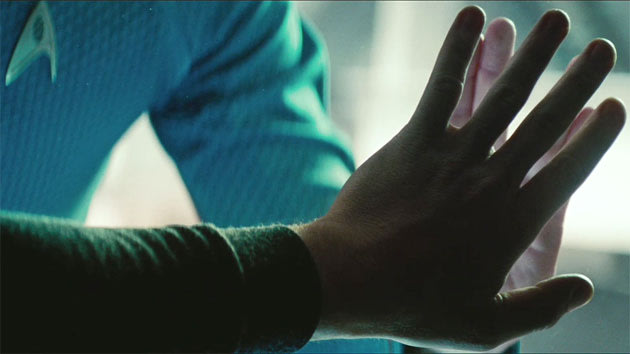 This kind of visual editing is the sort of thing you'd
expect from a promotional still, not laced thorough the entirety of the film,
and it only serves to detract further from the illusion of the film form.
Cumberbatch's monologue about his crew in the prison cell was a decent piece of
acting, written and delivered with the intent to hit us right in the feels, but
I just couldn't stop staring at how the lighting combined with his tears made
his eyes look completely unreal, again distracting from connection with
onscreen events.
This kind of visual editing is the sort of thing you'd
expect from a promotional still, not laced thorough the entirety of the film,
and it only serves to detract further from the illusion of the film form.
Cumberbatch's monologue about his crew in the prison cell was a decent piece of
acting, written and delivered with the intent to hit us right in the feels, but
I just couldn't stop staring at how the lighting combined with his tears made
his eyes look completely unreal, again distracting from connection with
onscreen events.
Similarity a minor continuity error
took me out of the scene at the moment of Kirk's death, the position of Spock's
hand switching from shot to reverse shot. The death scene is another example of a Wrath of Khan reference detracting from the onscreen events as not only are we aware of the switching of positions, it's never going to be quite as hard-hitting as Nimoy's "Don't grieve, Admiral..."
I'm not sure if Nimoy's casual
Spock appearance was entirely necessary either, like the presence of the
tribble it’s really just another form of fanservice that doesn't serve the film
well in the long run. Yes I’m aware that the tribble serves as a plot-point
method through which Bones is able to discover the regenerative properties of
Khan's blood which will eventually save Kirk, but that could have been achieved
by other means maybe oh yeah the Federation's investigation into the original
bombing discovering the source: Noel Clarke as the grieving father (Thomas
Harewood) and his dying daughter who provided the leverage which Khan used to
kick all this shit off. Most importantly, the Enterprise is kinda fucked now
that Bones brought the tribble back to life, cause we all know how this is
gonna end.
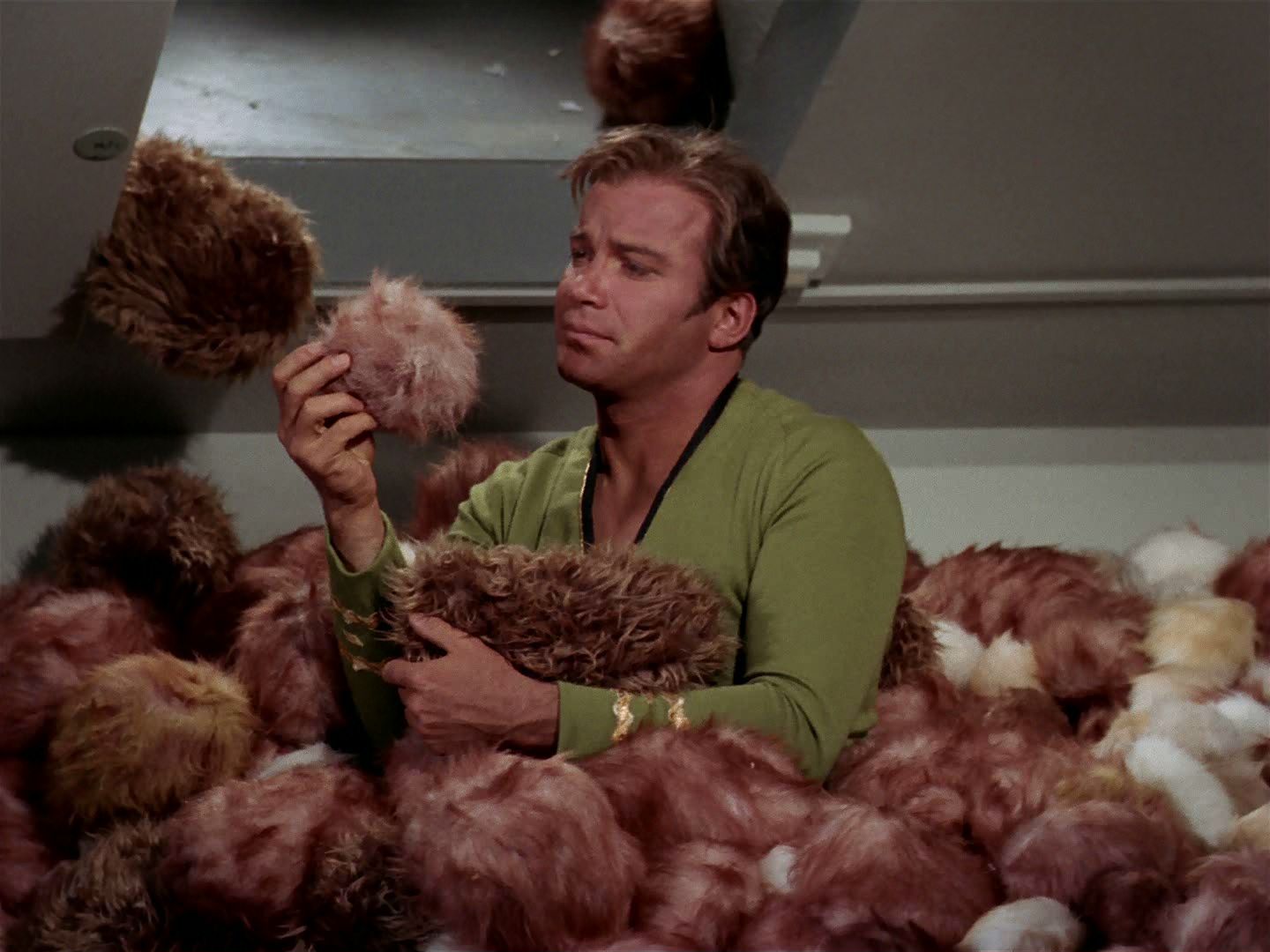 |
| Nipple deep in the furry little bastards, that's how. |
By constantly referring back to famous
scenes from the original we are constantly brought back out of the frame of Into Darkness. Through these methods of
form and content we can clearly see the seams of Abram's constructed reality,
and it doesn't take much picking at them before they begin unravelling.
With a few exceptions, the cast is
fairly strong (Karl Urban fails to live up to the dry humour or basic acting
abilities for Bones, or for any character really) but the characterisation is shallow
and the character development almost non-existent, most noticeably in the case
of the female characters. The original Star Trek series has been both
lauded for being progressive and critiqued for the sexism present in particular
episodes, but I'm not getting too far in that, I'll just leave this quote here
for anyone who's interested.
"Despite these progressive
overtures, there are many examples of sexism in Star Trek as well. There was no
female captain in the role of lead character until Captain Janeway in the
Voyager series. Women in The Next Generation were mostly relegated to nurturing
functions, a doctor and a counselor being the two most prominent female
characters. In the Original Series women were prohibited from being Starship
captains and wore revealing outfits" - via Geek Feminism
On the whole the original series
skirted the gender/race discourse fairly well, and it is regarded as being
progressive for its time. But the gender balance isn't great Into Darkness.
Something that annoyed me ever since I saw the trailer was the ever-present
shot of Dr. Carol Marcus (Alice Eve) in her underwear. This shot appeared,
seemingly quite out of place in amongst all the stuff getting blown up in the
trailers (what is this, a Michael Bay film?). But see here's the thing: her
nakitidy is not important to the plot whatsoever, (unless you're arguing that
it shows her strength of character in that she's not embarrassed about
undressing with Kirk in the room, but that argument seems flimsy at best.)
There is no romantic, or even sexual, relationship between her and any of the
other characters. Yes in the original canon Marcus and Kirk are lovers and they
have a son, but there's not even a hint of that here, rendering this shot completely
unneeded.
Dr. Marcus plays quite an active
role in her own events, sneaking her way on-board the Enterprise, running about
in her little blue dress disarming bombs and standing up to the overpowering
figure of the masculine stereotype that is her father, yet ultimately she fails
to have any real effect on the overarching narrative. The bravery she shows
when facing down both Admiral Marcus (Weller) and Khan is totally swept aside
by means of a transporter related kidnapping and a broken leg. Despite her
strengths she is still subject to the dominance of the stronger males. The main
driving force of the narrative falls to the male characters, in this case the
central core of Kirk, Spock and Khan. Even the slightly less centralised and developed-as-characters males,
Scotty, Bones, Chekov and Sulu, have more of an effect on the casual chain than
the two females, which is just a bit shite really when we consider the
strengths and weaknesses of the individual characters.
The theme of masculinity and
bromance (such a good word that) is almost overpoweringly present, to the point
that the main romantic relationship is kept in the background. The ‘Spock/Uhura’
relationship is underplayed here in favour of a collective ‘family/crew’
relationship, with Kirk even becoming an active participant in their lover's
spat.
 Zoe Saldana's Uhura should’ve been
  interesting, a strong and driven
character in her own right, she however spends the majority of the film getting
pissed off at Spock's blatant disregard for his own life and her feelings for
him because hey what's a strong female lieutenant without constantly pining
after her emotionally stunted man? (Disclaimer: Spock is an awesome and
interesting character, quite possibly my favourite from the series. I just
think there's too much emphasis placed on how much Uhura 'needs' him and not
enough on her as a character in her own right.) Her acceptance of his
explanation for why he would have allowed himself to die in the volcano seemed completely
out of alignment with her previously established character traits: “Oh so you
don't allow yourself to feel nor consider how your death would destroy me
because you care about me? Aww that's so sweet! I'm totally cool with you
having no disregard for your own life and my feelings now.”
interesting, a strong and driven
character in her own right, she however spends the majority of the film getting
pissed off at Spock's blatant disregard for his own life and her feelings for
him because hey what's a strong female lieutenant without constantly pining
after her emotionally stunted man? (Disclaimer: Spock is an awesome and
interesting character, quite possibly my favourite from the series. I just
think there's too much emphasis placed on how much Uhura 'needs' him and not
enough on her as a character in her own right.) Her acceptance of his
explanation for why he would have allowed himself to die in the volcano seemed completely
out of alignment with her previously established character traits: “Oh so you
don't allow yourself to feel nor consider how your death would destroy me
because you care about me? Aww that's so sweet! I'm totally cool with you
having no disregard for your own life and my feelings now.”
At the climax it's Spock and Uhura
vs Khan, and despite the fact that Khan was dropped to the floor by one stun
blast earlier in the film her repeated shots at him don't really have much
effect until Spock's inner masculine rage over the death of his friend (note: I
am playing to the stereotypes here) surfaces and he beats the living crap out
of him.
The reason I mentioned the gender
issue is that I find fandoms like Star Trek to be heavily male based,
both in the texts themselves and the discourse (fanbase) surrounding them
(another note: I'm generalising about ideological structures here and not
criticising male fans specifically). And I didn't find much in the female
characters to connect with, which is a shame because on paper they look pretty
promising. I think what people perceive as the typical 'fangirl' of franchises
like this fits into a very narrow, heavily stereotyped frame, and this is what
has been catered to here. But you can't just shoehorn an entire gender like
that, and here the appeal and mystery of emotional submersion within the world
of the Enterprise is dulled for me. Though it started out as such, modern
sci-fi isn't as much of a boys club as other genres have been and this just
seems like a big step backwards.
Pulling it back to characterisation
now, it’s not just the ladies that fall flat. Bringing back Khan but presenting
him in a slightly different angle was an interesting move, and I do think
Cumberbatch plays this version of Khan very well (if channelling a bit too much
Sherlock at times) but ultimately he never seemed that threatening,
particularly based upon prior knowledge of the character. So yeah he blew up a
couple of buildings, but after Marcus being a dick that was understandable and
for a good portion of the film the protagonist/antagonist definition was
blurred. His ('Oh by the way, I'm gonna conquer or destroy humanity and every
other species I deem inferior to my race') mass genocide plan was basically
just mentioned as an aside after the Spock on Spock Prime conversation to
remind us that this man is the antagonist so you can stop sympathising with him
now and place him back in the ‘villain’ sphere.
My problem is that Khan never
seemed like "the most dangerous enemy the Enterprise ever faced" as
Spock Prime described him. I don't think there was enough threat explicitly
presented behind his character to back up his arch nemesis status. Then again
maybe it was just different from what I was anticipating, given that the
promotional material released in the interim running up to the film's release
suggested that we were going to see a decimated city lying in ruins beneath the
boots of Khan, and what we got was so much less than that. By the end nothing
has really changed, Khan and the rest of his crew simply returned to the
cryo-tubes and filed away until the next time Abrams needs a classic villain to
serve as a plot point.

I wanted so badly to love this
film. I spent a long time anticipating it and got caught up in the hype long
before it was released, but ultimately it just fell flat. Overall I think it's
just kind of shallow, the writers (Orci, Kurtzman and Lindelof) too busy seeing
how many Star Trek references they could fit into two hours, forgetting
that this isn't some sort of audiovisual masturbation for pseudo-Trekkies (and
yes I used the prefix 'pseudo' for a reason). They've written in a couple of
sad scenes to the narrative and expected us to weep, but that's not how it
works. Good writing is subtle, and nothing about Into Darkness is
subtle. Having your characters go around announcing how they feel all the time
is unrealistic, boring and ultimately just kinda insulting to the audience.
I could write more but I feel this
post has already gotten long and rambly enough. Initially I was going to
conclude by saying that in the hands of a different director this film could've
been so much more (and I still think that's true) but I can't put all the blame
of Abrams here. It's just not great, a poorly made film based upon a poorly
written screenplay featuring poorly defined characters glossed over with the
Abram's 'all style and no substance' trademark sparkle. A few days after I saw the film some friends
and I watched Star Trek IV: The Voyage
Home (1986, Nimoy) and despite the fact that the script revolves around time
travelling whales and the positively cringeworthy attempts of the Enterprise
crew to navigate eighties San Francisco it was a lot more fun, more sincere,
had a much better gender balance and overarching themes than Into
Darkness did.
Now if you'll excuse me I kinda want to go watch Wrath of Khan.

No comments:
Post a Comment