Friday, 20 September 2013

On Documentary Referentiality [Academic Essay]

I realise that I haven't posted on here in several months, so here's an essay I did last semester that I added pictures to. AYE WHATEVER.


The infamous Grierson smoulder.
Documentary as a mode or genre of filmmaking has been subject to much debate since it’s classification in the early 90s. In Britain the mode as we know it developed under the wing of John Grierson’s Documentary Film Movement and the GPO Film Unit (later the Crown Film Unit). It was Grierson who coined the troublesome phrase often referred to as a definition of the mechanics of documentary: “the creative treatment of actuality” (1966). Grierson’s definition, though widely accepted as adequate, has raised much debate over the referential nature of the form. The main question; how much “fact”/actuality can survive the creative/“fictional” treatment of film as an art form? (Winston, 2008). Winston notes that despite image selection and manipulation the camera does create a “residual relationship” between the image and the subject but believes Grierson’s definition to be inadequate, describing it as “at best naïve and at worst a mark of duplicity” (pp.14 – 15). It is the supposed naivety of Grierson’s definition that has sparked such debate, because how do we define what is fact and what is fiction in a medium where the two are so closely related as to be almost indistinguishable at times?

Trying to define the boundaries between fact and fiction, actuality and aesthetics is a difficult task, and deciding where different forms of documentary fit within them is even more problematic. It is debatable whether such a clear cut boundary can be drawn at all. Nothing captured on camera can be argued to be innately ‘true’, the difficulty of the semiotic relations between the image and imaged best illustrated by René Magritte’s painting La trahison des images (The Treachery of Images). Magritte’s painting portrays a pipe with the caption “Ceci n'est pas une pipe” (“This is not a pipe") written below. Both the iconic image and linguistic symbol are representations of a pipe that may or may not exist in reality (Harris & Zucker, 2011). Magritte pinpoints the issue of referentiality here, illustrating the fact that the image is not a pipe, it is a representation. Even an image captured on camera can only be said to be a representation of a form of reality. This is why we discuss documentary in terms of referentiality, the degree of reference it holds to what we term the real.

Dai Vaughan (1983) made the distinction between film and other arts, such as drawing and sculpting, saying that when the painter attempts to capture the image of what he perceives to be a horse all he needs are his equipment, paint and canvas. The photographer/filmmaker however requires both his equipment and the presence of the actual horse. When the film has been processed what we are left with is two horses, the ‘actual’ horse as it exists in reality and the horse signified by the image captured on the film. The subject (the horse) thus possesses a “dual existence” (p.27) as it simultaneously exists as the physical object and the symbolic image outwith the reality of time/space relations (Vaughan, 1983). Charles Peirce identified this relationship as the “indexical bond” between image and reality (Izod & Kilborn, 1997). 

“…the documentary impulse… is, at its most rudimentary and irreducible, a desire and a requirement that the representation should keep faith with the materials: that the two horses should become, in some sense or other, one.” (Vaughan, p.28)

Vaughan makes the distinction between fiction and non-fiction by claiming that the desire of the documentarist is to keep the representation fully faithful to a truth inherent in the material of actuality. But is this possible? The widespread illusion of the camera as an all seeing, invisible eye causes further problems here.

In the discourse of fiction, and some non-fiction (e.g. certain types of direct-cinema), the camera does not exist within the diegesis of the film and so creates an illusion of actuality which works to draw us into the created reality of that world. In documentary the camera does exist as a physical, intrusive object and thus has an effect on unscripted action. Using Vaughan’s example we can understand how the behaviour of the subject(s) change when aware of the presence of the camera and filmmaker(s). The horse would react differently when confronted with the presence of a camera crew as opposed to that of its owner or an empty field, and thus the filmic portrayal of the horse differs from the normal reality of its existence (Izod & Kilborn, 1997). Vaughan responded by charting a distinction between ‘pro-filmic’ and ‘putative’ events. The pro-filmic refers to all events which occur and are captured by the camera. The putative event is what would have occurred had the camera not been present. The behaviour of self-aware human subjects is particularly vulnerable to alteration by the presence of the camera and this is something that we must bear in mind in critical discussions of the genre.

While it is evident that the referentiality issue is not so simple as the view that what is captured on camera is indicative of reality, similarly nothing can be claimed to entirely fictional. Even the most outlandish feature still has a basis in reality, the rules of the universe and the laws of physics still apply. Even sci-fi and fantasy films still have an epistemological basis, no matter how fragile the referentiality may be. Bearing this in mind it is clear that the boundaries between fact and fiction are anything but clear cut. What is captured upon the film will always be an imperfect representation of actuality and arguably has no inherent truth quality.

Cousins and Macdonald (2006) wrote that rather than simply attempting to capture reality the various modes of documentary tamper with or organise reality in certain creative manners pertaining to their individual modes. Documentary is not just a mere recording of pro-filmic events. It is through the use of techniques of form and aesthetics that the filmmaker creates meaning, shaping the ‘fragments of reality’ into a coherent narrative which unfolds for the purpose of the viewer. This is where the distinction between ‘documentary’ and earlier ‘actuality’ films (such as those of the Lumière brothers) becomes apparent. In documentary processes of narrative and editing are used to shape the ‘fragments of reality’ into an ‘artefact’ and thus create meaning (Izod & Kilborn, 1997). At its core cinema is an art and as with all artistic form holds a degree of subjectivity (Harding, 2013). Aesthetic and form techniques traditionally associated with cinema such as narrative, framing and editing have a profound influence on the meaning of the finished artefact.

One of the earliest and most well-known examples of documentary that merged referentiality with aesthetics and form is that of Night Mail (1936) produced by the GPO Unit under Grierson. While Night Mail sets out to chart the actuality of the mail train it uses a mixture of dramatic and documentary techniques to do so. Night Mail features a casual narrative which charts a day and a night in the life of the workers on board the train, following it on its journey through England and Scotland. The ‘voice-of-God’ commentary of direct audience address is used to describe the onscreen actions, a tenant of the expository mode. Elements of the dramatic and poetic are brought in through aligning the rhythms of the train with the editing and both diegetic and non-diegetic sound. As the train approaches its destination the famous poetry/music sequence plays out alongside montage editing, the pace and rhythms building in time with the spoken word. Here Night Mail plays with the poetic mode as the visuals of the world are arranged with poetry and music to create an artistic artefact designed to evoke a specific mood, namely that of regional pride and unity (Aitken, 1998).


 The issue of reconstructed events is one that has been prevalent in documentary from its formulation. In Night Mail reconstruction was necessary in order to film the interior of a mail-truck, a space that was inaccessible to the filmmakers using the technology of the time period. The mail-truck was in fact a studio set, open at the side to allow the camera to film and built with a mechanism that allowed it to be rocked from side to side to construct the movement of the train (Paget, 2011). Reconstruction of this type was necessary as neither the video nor audio recording equipment of the period could be employed upon an actual mail train. The reconstruction itself was based in ‘prior witnessed reality’ and was employed as a means of telling the story of the night mail train. The same type of reconstruction is seen in Nanook of the North (1922) in which Flaherty reconstructed interior igloo scenes as actual igloos were too small and dark to film in (Silver, 1996). In instances like this technology and space limitations meant that this ‘fictional’ approach was the most convenient way to portray a sense of actuality. There was, as Paget wrote in the title of this book, “no other way to tell it".

Despite the fact that reconstruction is present Night Mail is still classified as expository documentary cinema rather than fiction. Beyond semiotics and the use of dramatic techniques further problems of referentiality are posed by the hybridisation of documentary modes. Just as it is difficult to draw a line between fact and fiction the classification of certain types of documentary pose difficulties as the different modes have a tendency to bleed into each other. Most controversial of the modes is that of dramatized documentary (docudrama). Docudrama is a mode which focuses on the dramatic, using techniques associated with fictional dramatization to create a semi-fictional story with a basis in documentary style research. Docudrama has long been a controversial mode in the documentary debate; frequently accused of blurring the boundaries of reality and fiction.  Indeed the definitions of the category itself are not set in stone, leading some to claim that docudrama is not a new mode but a non-classification which has always existed to an extent in all forms of drama and documentary (Goodwin & Kerr, 1984).

Ken Loach’s docudrama on homelessness, Cathy Come Home (1966), is one of the most widely discussed, partially because of the socio-political impact it was believed to have had upon its release. Docudrama works from a basis of facts but uses dramatization to encourage reflection and action from identification with the audience. Cathy Come Home utilises a blend of techniques associated with both fictional drama and factual documentary; a fictional narrative; conventions of documentary form such as voice-over and interview material; real life locations and a mixture of professional and non-professional actors (Stafford, 2013). It was based upon a “tightly referential journalistic core” (Corner, 1996, p.105) which assures at least a degree of the factuality associated with documentary. As we draw nearer the conclusion there is a moment where Cathy’s character appears to directly address the camera for the first (and only) time, but as the camera pans it is revealed that she was actually talking to Reg standing outside of the frame. The viewer with a mind aware of the conventions of the documentary mode is caught within an illusion of immediacy here, the effect unsettling. This scene more than any illustrates the mixture of documentary and drama, and how easily misled the viewer can be by the selection of certain images.

Paget (2011) stresses that docudrama is not a mode indented to convey absolute truth, rather “…composites intended to convey broad truths about something of social importance” (pp.15 – 16). He argues that the use of drama in docudrama is important in that it “excites” the audience and thus encourages social/political debate (p.19). The viewer’s interest and imagination are captured by the fictional reality presented in the typical drama film. Morris wrote “there is such a thing as truth, but we often have a vested interest in ignoring it or outright denying it” (quoted in Anthony, 2013). Docudrama uses a construction of dramatic techniques to make it harder for the viewer to ignore the truth of the situation. In docudrama they become emotionally involved through the immersion of the dramatic techniques whilst simultaneously anchored in referentiality with the ‘real world’ through the use of intrusive documentary style. At the conclusion of Cathy Come Home we are not pushed from that world but pulled further into it, reminded that Cathy’s world is in fact our own, her reality that of many young mothers in Britain. 

“…the relationship between film and reality is not a straightforward or literal one, but that of a metaphor.” (Cousins & Macdonald, 2006, p.5) 

The fact that Cathy, a character who never physically existed, can possess her own truth which corresponds with the actuality of what we would term our reality is a powerful tool in the effectiveness of docudrama. The character of Cathy reads like an extended metaphor or symbol, but while the artistry of the symbolic may be said to be a fictional construction there still exists a point of referentiality from which it stems. The events which happened to Cathy and her family within the fiction of the film happened to thousands of other families in reality (Sandford, 1971). She is an amalgamation of the situations of various different people, a point upon which Sandford and Loach have been criticised, accused of lumping together the worst occurrences into a single situation. However this criticism backfired when investigation revealed families in worst situations than Cathy herself.

So how is reconstruction out of necessity different from the reconstruction associated with docudrama? Can we say that the type of fakery used in Night Mail is acceptable but the reconstruction of wider social events such as those seen in Cathy Come Home (1966) is not? There exists a dialect of degrees of actuality that we must always be consciously aware of when discussing the division of fact and fiction in documentary. As previously discussed even the modes of documentary that are widely taken to have an inherent actuality claim cannot be said to be fully factual, and so such a claim that docudrama has no referential value seems based in an indefensible stance of epistemological confidence. Can docudrama be said to blur boundaries where in fact it is debatable that such boundaries even exist?

Apparatus theory teaches us that viewers are caught within a trap of false identification with onscreen events, and filmmakers such as Loach have been criticised for fooling the viewer into accepting fiction as fact through docudramas attempts to conceal the apparatus of documentary modes. But we must be aware both of the viewer as an active, thinking being and of the sliding scale of objectivity/subjectivity present in all forms of cinema. Though it may at times disorientate, documentary does not actively attempt to deceive the viewer with the blurring of fact/fiction boundaries (Corner, 1996). The fact remains that it is debatable that such boundaries even exist. 

Monday, 8 July 2013

Quick Review Type Thing In Which I Talk About Plot & Character in 'World War Z'


*Minor spoiler alerts*

World War Z, 2013
Director: Marc Forster
Writers: Matthew Michael Carnahan, Drew Goddard & Damon Lindelof
Starring: Brad Pitt; Mireille Enos; Daniella Kertesz; Ludi Boeken; Fana Mokoena; Pierfrancesco Favino; Ruth Negga & Peter Capaldi.

So I've had the, uh, pleasure of seeing World War Z twice now, and when I say that I was slightly surprised upon initial viewing it is only because I had such low expectations going into it. 

World War Z was a film plagued with production issues from the get-go, including numerous re-shoots, re-writes, arguments between cast and director and the complete re-haul of the finale in order to make a more "acceptable" ending for the Hollywood audience (I can only assume this is a synonym for "cheesy"). When I watch summer Hollywood blockbusters for the first time I always try to take them with a pinch of salt and try not to over-analyse them too much (unless I feel particularly spurned by them, as I have been this summer) but WWZ just made it kinda easy.

The thing that pitfalls WWZ is the same thing which plagued The Walking Dead TV series (Darabont). In a nutshell: the inherent, privileged dominance of the American, middle-class white male and the overwhelming importance of his nuclear family. This is encapsulated nicely in the scene where Gerry Lane (Brad Pitt) is shot down whilst panicking over the safety of his family by one of the unnamed W.H.O doctors (Pierfrancesco Favino) telling him how he lost his family. Their exchange here is almost identical to one from The Walking Dead wherein Rick (Andrew Lincoln) is reminded that he's the only one who hasn't actually lost anyone from his immediate family and highlights how he uses every other character as a stepping stone to achieve that singular end. This ideology is imposed upon us throughout and involves a family of characters which are difficult to connect withThe white, middle-class family held aloft by the protagonist character is not only shallow and poorly developed, but self-involved and self-important, rending them unlikable as characters and the audience completely unsympathetic to their continued survival.

"Gerry obviously cares about his family. It's just the rest of us who don't, and that's where “World War Z” falls short of what it might have been." (Tribune Review, 2013)


Gerry Lane is our archetypal dominant male character, initially presented as being devoted completely to his family to the point of directionlessness in his professional life. When the shit hits the fan suddenly he is forced to take up his old mantle, because apparently he is the only person alive who can possibly do anything about this situation. Pitt's performance was decent, but nothing to write home about. He's one of those actors who is fantastic under a certain type of direction and in a certain type of film, but this was no Assassination of Jesse James or Fight Club. We have what seems to be the beginning of a partnership set up alongside him in the form of Dr. Fassbach (Elyes Gabel). While Gerry embodies stereotypical physical masculinity, Fassbach is portrayed as a paragon of intelligence, displayed so very eloquently by his analysis of Mother Nature's methods (hint: that was a bit sarcastic). This highly intelligent man, humanities last best hope, then manages to shoot himself in the face five minutes after we're introduced to the character. Gerry then uses what Fassbach told him about Mother Nature in what I term a Dr. House moment with what I can only assume is his vast and as of yet untapped well of bio-medical knowledge. I won't go so far as to call this anti-intellectualism, but the action renders Fassbach just kinda pointless as a character in his own right, reduced to a vessel with five minutes of screentime who only functions to implant a spark in our hero's mind before dying in an act of clumsiness and panic. And it's not just Fassbach, everyone else is presented as inferior to Lane through lack of development and action. We are to understand that he is the important one, the only one who is supposed to be able to fix everything yet leaves leaves a trail of death and destruction in his wake in the process, a price which is paid by every character but Lane.

Gender politics are disappointingly typical and boring here, our main female character (Karin Lane, played by Mireille Enos) firmly relegated to the role of the wife, a maternal figure who remains passive and is always secondary not only to her husband but to the other males. The secondary female lead representation, Daniella Kertesz's Segen, places far to the other end of the feminine representation spectrum, the shaved head and combat uniform reminiscent of Moore's G.I. Jane (Scott, 1997) and she's arguably the most badass character in the film (beating up zombies with a baseball bat after having her hand cut off - very Evil Dead). She would certainly have been my favourite, if not for the complete lack of character development. She's a strong woman yes, but she's really just a cardboard cut out, an archetype who exists in this narrative to react to Lane rather than function as any kind of driving force.

The plot jumps around like a mad thing on drugs, leaping from nonsensical point to point in a cheap and unrewarding manner. Finding the ex-C.I.A.agent who somehow knows everything about what's going on despite the fact he's been locked in a jail cell and who points Lane towards the next destination; the explanation for why Israel (Jerusalem) finished building their wall and the means by which they did it and Lane's sudden bright spark arrival at the biological camouflage idea just a few of the big gaping holes. As is most cinema, action films are allowed a certain amount of leeway with things like filmic reality and the laws of physics, but the Lane and Segen surviving the plane-exploding-crashing, giant piece of metal through the chest scene just pushes the boundaries of believably too far. Even in a film about zombies.

Plot point breadcrumbs are dropped that are never picked back up on, little ones like Capt Speke (James Badge Dale) giving Lane his ring to pass to his mother to the big missed connection in the constant sense of threat to Lane's family. This was displayed throughout the film through the drawn out debates over them being allowed to stay on the boat and Lane's frantic insistences that they are not safe in the refugee camp leading us to a conclusion which is never picked back up upon, leaving us which a soft, unconvincing and wholly dissatisfactory ending

A big criticism which others have made revolves around how far the book diverges from the source material. Brooks himself came out and said that the only thing which his book and the film have in common is the title. What I will point out is the divide between the social commentary contained in the book and the lack of it in the film. Just because Jerry goes to different places, kills different nationalities of zombies, doesn't mean that the text is making any significant comment upon them. You can argue that social ideologies will always fall secondary to mindless entertainment in the Hollywood summer blockbuster, but it's always a terrible shame to see something which started out as such reduced to mere thoughtless audiovisuals.

I didn't hate World War Z, I wasn't expecting much but I did go into it hoping I would enjoy it. I'm a huge horror fan and love zombie films but in the end it's nothing new, nothing which hasn't been done before, it's it's all just bigger budget, faster paced and on a bigger, more superficial scale.

Sunday, 19 May 2013

Iron Man 3: Short Review

Very short review of Iron Man 3 (2013) which I went to see on opening night at midnight when it came out. I'm super lazy so I'm basically just going to regurgitate my fragmented Twitter review in blog format. Oh yeah SPOILER ALERTS.

Iron Man 3
Director: Shane Black
Writers: Drew Pearce & Shane Black
Starring: Robert Downey Jr., Gwyneth Paltrow, Guy Pearce, Rebecca Hall, Ben Kingsley.

So at the conclusion of the film I turned to the person next to me and said "That was pretty awesome." "...Really?" He replied. When I went to see Star Trek: Into Darkness last week the same thing happened, with the positions reversed. Ultimately I've decided that Iron Man 3 falls into The Avengers (or Avengers Assemble, whatever) (2012, Whedon) category for me. I enjoyed the escapism of watching it at the time, but on further reflection ultimately found it hopelessly flawed and just a bit rubbish really.

Tony Stark has always been by his very nature, a roguish, seemingly-unaffected playboy. It's not often that we get to see a darker, more serious side to his personality. The psychology of the Iron Man suit is something that has long been a running theme through the films and graphic novels, and this could've been an opportunity to further explore what lies beneath the surface, and the separation of Stark from the Iron Man persona. Instead what we get is a film that makes explicit references to trying to go in for something darker but essentially toes the tragicomedy line a little too finely, rendering Stark's emotion pain and PTSD shallow and unaffecting. The humour itself was often quite poor and totally undermined any attempt to explore the psyche. There's a couple of references to what Stark/Iron Man went through during the events of The Avengers, but no real development on that beyond the weird conversations he has with the kid and the occasional panic attacks, which conveniently stop happening right around the climax of the film and are never mentioned again.

I can't really fault the acting, Downey Jr. is the epitome of Tony Stark as always. Guy Pearce has previously endeared himself to me through his work with John Hillcoat and he does make a superb, sleazy villain. Ben Kingsley is a great actor, and he shows it here through his dual role, though he is seriously underused. Paltrow is, well, I've never really liked her as an actress, nor I have I liked her Iron Man character. Upgraded here to official 'Iron Man's girlfriend' status, Pepper becomes even more of an annoying Mary-Jane, centre of everyone's universe, character. She is the central female, the one that all the male characters are concerned about all the time. There's even a moment where, when kidnapped, she refers to herself as Killian's (Pearce) "trophy". The only other central female character, Maya, intelligent, likeable, shrewd, is eventually denounced, punished and forgotten for daring to get too close to Stark. (But she's a brunette, so I guess we shoulda seen that coming.) And what the hell is up with a) The fact that Pepper survived falling from a great height into a fiery explosion whilst other extremis altered characters were taken out by much less and b) her seemingly flame retardant bra.

On the subject of characters, there's been a lively debate around The Mandarin in Iron Man 3. Personally I think that the way they subverted everyone's expectations isn't a terrible thing, but I would much rather have seen more of Kingsley portraying The Mandarin as opposed to Trevor Slattery, particularly some confrontation between Iron Man and The Mandarin with his character functioning as a real antagonist instead of a mere front. Arguably that plotline also throws up some thorny issues of race and terrorism, exemplified through Kingsley's musings on the origins of fortune cookies.

Overall, the story was just a bit too silly. And what was the point of setting it at Christmas? The continual references to the time of year used as a poor form of emotional connection or cheesy comic relief, I'm not sure which. I'm not saying it was an awful film, it was better put together than its predecessor (Iron Man 2, 2010) but with the materials available the finished product could've been so much more than it was. The references to Tony's PTSD, the making of the suits as therapy (which ultimately doesn't work because hello, he's been making things all his life, it's not like it's some new behaviour here), the nature of The Mandarin, all are interesting plot points which raise issues of psychology and performativity that, if explored further, could've made for a really interesting film. Instead we have this, mindless action and antagonist fire-people who burn and explode from the inside out (seriously?). Now, I don't remember that being part of the Extremis canon.

Going to finish by tying this into my previous post about Star Trek: Into Darkness as these are two new films I've seen in the last couple weeks, both of which I had very different initial reactions too. At the end of Iron Man 3 I was like 'woah that was awesome', but after going away and thinking about it decided that it wasn't actually that good. I definitely found it more engaging than Into Darkness though (see my previous post for reasons...), and at the end of Into Darkness I was the only one out of my group of friends sitting going "Eh... It was okay I guess." But in the end I don't think either of them were particularly awesome, which is a shame. But then what do I know, I just bought Silent Hill: Revelation on DVD. Actually, I think I'm gonna go watch that now. Later alligators.

Star Trek: Into Blinding Lights All Up In Your Face


Before I start and possibly get into trouble, SPOILER ALERTS FOLLOW. 

Ahem. 

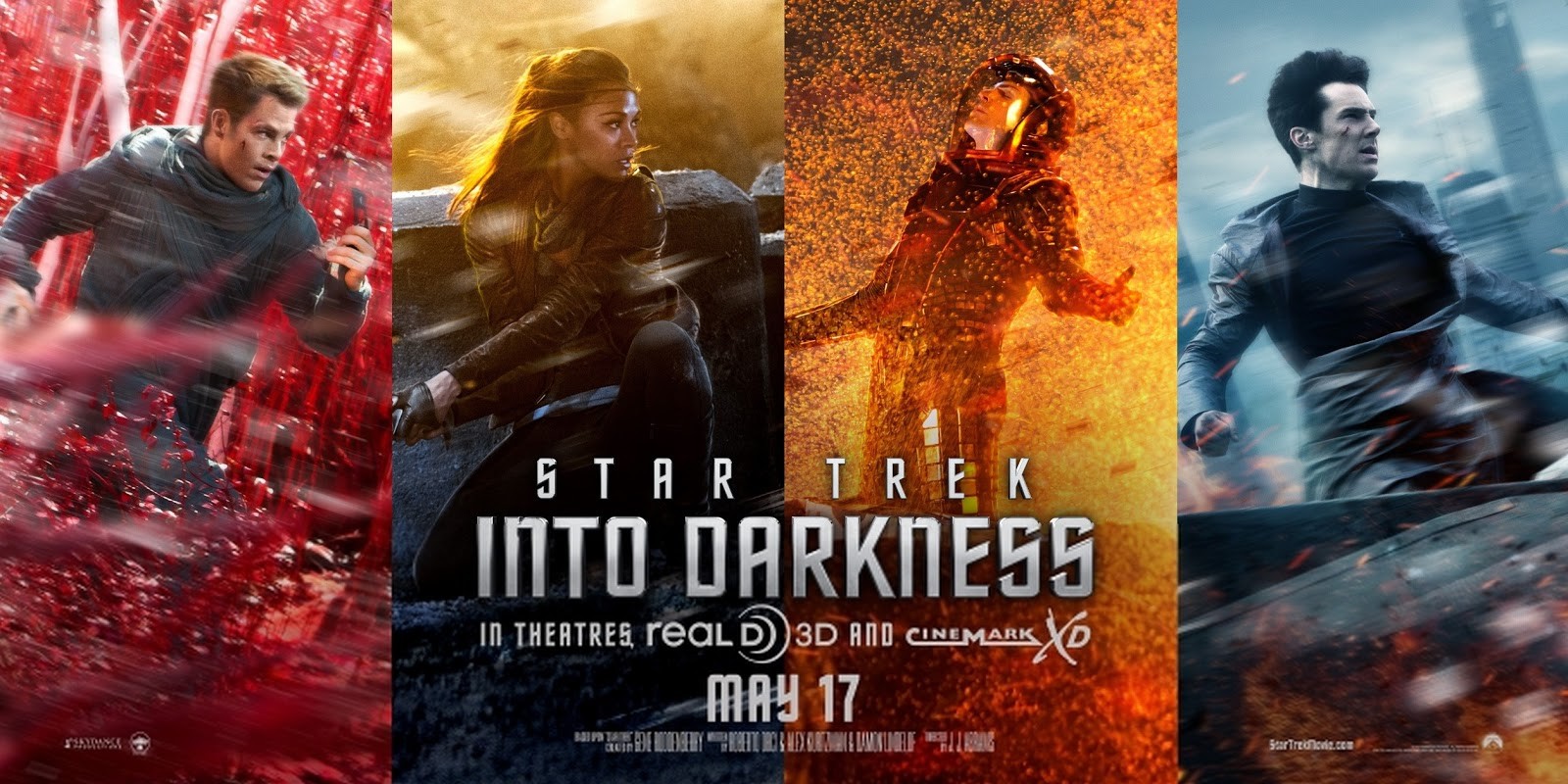
Like a good percentage of the world I was super duper excited for Star Trek: Into Darkness (2013, Abrams). I went to see it last weekend, a few days after its release, and all I had heard about it in the interim was that it was incredible.

Originally I wasn't going to bother writing a post about Star Trek as diving into the hornets’ nest of a popular film based in an incredibly popular fandom is something I try to avoid, but after a conversation I was barely involved in in the pub with two friends who are long-time fans I decided whatever no-one's gonna read this anyway.

A point to make first: I am not a Trekkie. I can see the attraction of the fandom and feel that if I sat down and re-watched the series I probably would be, but as it currently stands I am in no way intimately familiar with the Star Trek canon. It was one of those shows I watched when I was younger, and enjoyed at the time, but have not seen since. My biggest memory of it is my Dad teaching me how to do the Vulcan salute (yeah I was cool as fuck) and little points of reference. So my memory of and emotional connection to the series is patchy at best.

So here you have a Star Trek post written by someone who will admit to perhaps not being the best person to discuss the intricacies of the film's narrative canon and characterisation. Bear that in mind. What I am discussing here is not how well the film worked as part and parcel of the Star Trek series, what I'm concerned with, and the reason why I think I didn't enjoy it as much as I had anticipated, is down to the film itself, more specifically, it's down to how Abrams handled the film.

During conversations I've had with people about Into Darkness two points have been raised: that if you're already engaged in the fandom you will either enjoy the film because it retains enough points of reference (including direct fanservice) to recall that original emotion, or you will hate it for the lack of imagination shown in just recycling (and essentially perverting) plot points from previous films with a little character switcharound (eg Quinto's re-enactment of Shatner's famous line from Star Trek II: The Wrath of Khan (1985, Meyer).)

 
Let's watch it again, just for fun.

The main issue with the content of the film stems from the emphasis on mindless action and the rehashing of famous scenes from the original Trek films (specifically Wrath of Khan). A cliché revenge/conspiracy film, there's a distinct lack of boldy going where no one has gone before, which is after all, the heart of the Star Trek storyline

"The biggest problem comes with the revelation of the worst kept secret of the film.  That “John Harrison” is in fact Khan and that the 3rd act is Abrams and Co. doing cover versions of Wrath of Khan scenes.  So that instead of Spock sacrificing himself to save the crew by going into the radiation chamber and Kirk yelling “Khaaaannn”, it’s the other way around.  It is fan service at its worst.  They are undeserved emotionally and are pandering imitations, compounded by an unnecessary final action scene and a deus ex machina that they already had at their disposal.  And the fact that it ends with Khan and his supermen back in the cryo tubes means that they can trot him back out whenever they feel like it, which is the last thing they need at this point." - Annand (2013) 

But the problem with Into Darkness is not just necessarily its content, it's the form. A friend of mine who came to a similar conclusion (and is also writing his own post on this which will probably make mine look even more like drunken ramblings) described it as "a film about personal connections and sacrifice where the audience can't connect". This is the crux of the problem. At the big heart-string pulling scenes (you know the ones) I found myself sitting wondering why I was not welling up. I'm a bit of a sap when it comes to connecting with films, I cry at the drop of a hat but here small things kept me from that strong emotional connection with the characters: continuity errors, suspect acting, cliché dialogue and Abrams' ever intrusive cinematic form.

Undoubtedly Into Darkness can be classed as a mainstream film. Despite the sci-fi genre it contains a baseline of classical Hollywood form, the narrative emphasis placed upon the psychological motivations of the characters. These are well-established throughout, the film is based in emotion and the focus is on the human characters. Though the aspect of romance is underplayed it is still present, though perhaps most notably through the unstable 'bromance' between Kirk and Spock. The characters are goal orientated, driven by psychological desires (emotion: pride, duty, love) and the main drivers of the narrative are the central male characters.

This type of film requires the emotional/intellectual immersions of the audience within the world of the text in order for it to work on any kind of significant, emotive level. But here we are all too aware of the barrier between spectator and subject. The Hollywood form is based upon a discourse of invisible style and continuity editing: the camera functions as the invisible, unobtrusive eye of the viewer which is designed not to draw attention to itself. In my opinion Abrams succeeds only in distancing us from the connecting with the bonds which form the crux of the narrative themes. This was a film with an incredible amount of heart, but the viewer could not feel it and so could not connect with the characters. We are firmly and constantly reminded of our position as spectators upon a screen.

Firstly, those bloody lens flares. Now this has been said so many times already that it's become a cliché when discussing Abrams, if you Google 'lens flares' the second entry is an article about Abrams discussing his overuse of lens flares in Star Trek(2009). He admits here that he went a bit mental with them, explaining that his reason for doing so was that he wanted a visual motif to illustrate the "brightness" of the future. But a lens flare is a mistake. It is what happens when light reflects across the surface of the camera lens. When used purposely they add drama through an unedited sense of realism. But nothing about this film subscribes to unedited realism, instead in order to keep us emotionally engaged it needs to hide the huge amount of fabrication that is going on in the background. Lens flares don't happen in the eye and seeing them onscreen serves only to remind us that we are viewing these events through a camera.

The lighting is just insane in general. Okay Abrams, we get it, the future is a bright place. Calm yourself down. Everything is clinical, oversaturated and so incredibly bright that the Enterprise crew should be supplied with regulation sunglasses. The colour of everyone's eyes gets a bit ridiculous, particularly Kirk. Everytime we cut to a close up of Pine I was immediately distracted by the huge colour boost of the blue in his eyes. 

This kind of visual editing is the sort of thing you'd expect from a promotional still, not laced thorough the entirety of the film, and it only serves to detract further from the illusion of the film form. Cumberbatch's monologue about his crew in the prison cell was a decent piece of acting, written and delivered with the intent to hit us right in the feels, but I just couldn't stop staring at how the lighting combined with his tears made his eyes look completely unreal, again distracting from connection with onscreen events.

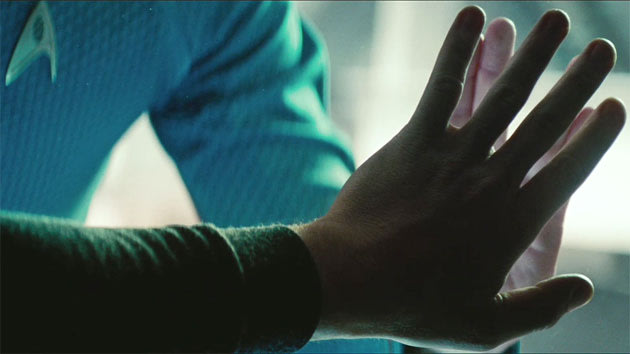
Similarity a minor continuity error took me out of the scene at the moment of Kirk's death, the position of Spock's hand switching from shot to reverse shot. The death scene is another example of a Wrath of Khan reference detracting from the onscreen events as not only are we aware of the switching of positions, it's never going to be quite as hard-hitting as Nimoy's "Don't grieve, Admiral..."

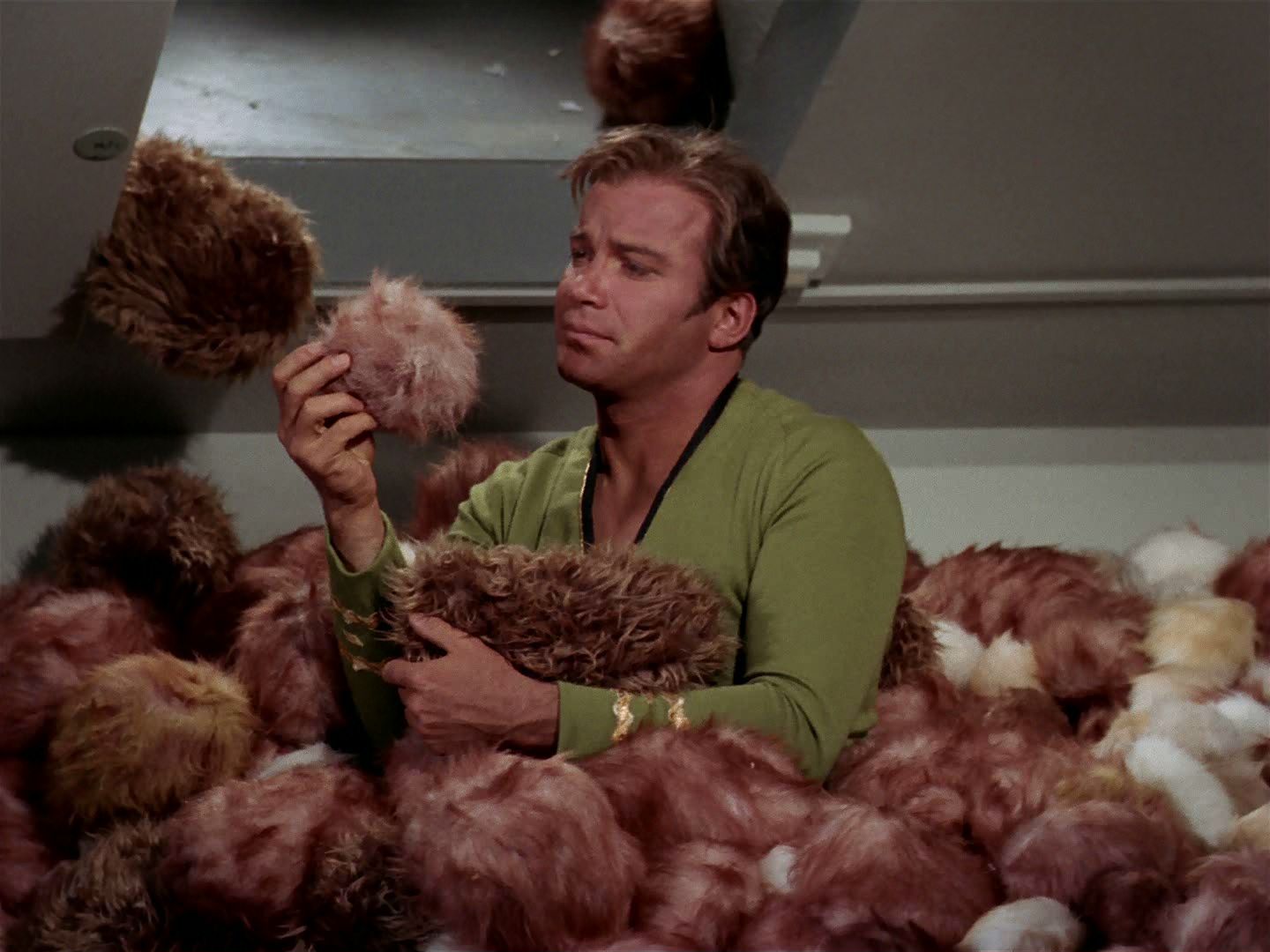
I'm not sure if Nimoy's casual Spock appearance was entirely necessary either, like the presence of the tribble it’s really just another form of fanservice that doesn't serve the film well in the long run. Yes I’m aware that the tribble serves as a plot-point method through which Bones is able to discover the regenerative properties of Khan's blood which will eventually save Kirk, but that could have been achieved by other means maybe oh yeah the Federation's investigation into the original bombing discovering the source: Noel Clarke as the grieving father (Thomas Harewood) and his dying daughter who provided the leverage which Khan used to kick all this shit off. Most importantly, the Enterprise is kinda fucked now that Bones brought the tribble back to life, cause we all know how this is gonna end.

Nipple deep in the furry little bastards, that's how.
By constantly referring back to famous scenes from the original we are constantly brought back out of the frame of Into Darkness. Through these methods of form and content we can clearly see the seams of Abram's constructed reality, and it doesn't take much picking at them before they begin unravelling.

With a few exceptions, the cast is fairly strong (Karl Urban fails to live up to the dry humour or basic acting abilities for Bones, or for any character really) but the characterisation is shallow and the character development almost non-existent, most noticeably in the case of the female characters. The original Star Trek series has been both lauded for being progressive and critiqued for the sexism present in particular episodes, but I'm not getting too far in that, I'll just leave this quote here for anyone who's interested.

"Despite these progressive overtures, there are many examples of sexism in Star Trek as well. There was no female captain in the role of lead character until Captain Janeway in the Voyager series. Women in The Next Generation were mostly relegated to nurturing functions, a doctor and a counselor being the two most prominent female characters. In the Original Series women were prohibited from being Starship captains and wore revealing outfits" - via Geek Feminism 

On the whole the original series skirted the gender/race discourse fairly well, and it is regarded as being progressive for its time. But the gender balance isn't great Into Darkness. Something that annoyed me ever since I saw the trailer was the ever-present shot of Dr. Carol Marcus (Alice Eve) in her underwear. This shot appeared, seemingly quite out of place in amongst all the stuff getting blown up in the trailers (what is this, a Michael Bay film?). But see here's the thing: her nakitidy is not important to the plot whatsoever, (unless you're arguing that it shows her strength of character in that she's not embarrassed about undressing with Kirk in the room, but that argument seems flimsy at best.) There is no romantic, or even sexual, relationship between her and any of the other characters. Yes in the original canon Marcus and Kirk are lovers and they have a son, but there's not even a hint of that here, rendering this shot completely unneeded. 

Dr. Marcus plays quite an active role in her own events, sneaking her way on-board the Enterprise, running about in her little blue dress disarming bombs and standing up to the overpowering figure of the masculine stereotype that is her father, yet ultimately she fails to have any real effect on the overarching narrative. The bravery she shows when facing down both Admiral Marcus (Weller) and Khan is totally swept aside by means of a transporter related kidnapping and a broken leg. Despite her strengths she is still subject to the dominance of the stronger males. The main driving force of the narrative falls to the male characters, in this case the central core of Kirk, Spock and Khan. Even the slightly less centralised and developed-as-characters males, Scotty, Bones, Chekov and Sulu, have more of an effect on the casual chain than the two females, which is just a bit shite really when we consider the strengths and weaknesses of the individual characters.

The theme of masculinity and bromance (such a good word that) is almost overpoweringly present, to the point that the main romantic relationship is kept in the background. The ‘Spock/Uhura’ relationship is underplayed here in favour of a collective ‘family/crew’ relationship, with Kirk even becoming an active participant in their lover's spat. 

Zoe Saldana's Uhura should’ve been interesting, a strong and driven character in her own right, she however spends the majority of the film getting pissed off at Spock's blatant disregard for his own life and her feelings for him because hey what's a strong female lieutenant without constantly pining after her emotionally stunted man? (Disclaimer: Spock is an awesome and interesting character, quite possibly my favourite from the series. I just think there's too much emphasis placed on how much Uhura 'needs' him and not enough on her as a character in her own right.) Her acceptance of his explanation for why he would have allowed himself to die in the volcano seemed completely out of alignment with her previously established character traits: “Oh so you don't allow yourself to feel nor consider how your death would destroy me because you care about me? Aww that's so sweet! I'm totally cool with you having no disregard for your own life and my feelings now.”

At the climax it's Spock and Uhura vs Khan, and despite the fact that Khan was dropped to the floor by one stun blast earlier in the film her repeated shots at him don't really have much effect until Spock's inner masculine rage over the death of his friend (note: I am playing to the stereotypes here) surfaces and he beats the living crap out of him.

The reason I mentioned the gender issue is that I find fandoms like Star Trek to be heavily male based, both in the texts themselves and the discourse (fanbase) surrounding them (another note: I'm generalising about ideological structures here and not criticising male fans specifically). And I didn't find much in the female characters to connect with, which is a shame because on paper they look pretty promising. I think what people perceive as the typical 'fangirl' of franchises like this fits into a very narrow, heavily stereotyped frame, and this is what has been catered to here. But you can't just shoehorn an entire gender like that, and here the appeal and mystery of emotional submersion within the world of the Enterprise is dulled for me. Though it started out as such, modern sci-fi isn't as much of a boys club as other genres have been and this just seems like a big step backwards.

Pulling it back to characterisation now, it’s not just the ladies that fall flat. Bringing back Khan but presenting him in a slightly different angle was an interesting move, and I do think Cumberbatch plays this version of Khan very well (if channelling a bit too much Sherlock at times) but ultimately he never seemed that threatening, particularly based upon prior knowledge of the character. So yeah he blew up a couple of buildings, but after Marcus being a dick that was understandable and for a good portion of the film the protagonist/antagonist definition was blurred. His ('Oh by the way, I'm gonna conquer or destroy humanity and every other species I deem inferior to my race') mass genocide plan was basically just mentioned as an aside after the Spock on Spock Prime conversation to remind us that this man is the antagonist so you can stop sympathising with him now and place him back in the ‘villain’ sphere.

My problem is that Khan never seemed like "the most dangerous enemy the Enterprise ever faced" as Spock Prime described him. I don't think there was enough threat explicitly presented behind his character to back up his arch nemesis status. Then again maybe it was just different from what I was anticipating, given that the promotional material released in the interim running up to the film's release suggested that we were going to see a decimated city lying in ruins beneath the boots of Khan, and what we got was so much less than that. By the end nothing has really changed, Khan and the rest of his crew simply returned to the cryo-tubes and filed away until the next time Abrams needs a classic villain to serve as a plot point.


I wanted so badly to love this film. I spent a long time anticipating it and got caught up in the hype long before it was released, but ultimately it just fell flat. Overall I think it's just kind of shallow, the writers (Orci, Kurtzman and Lindelof) too busy seeing how many Star Trek references they could fit into two hours, forgetting that this isn't some sort of audiovisual masturbation for pseudo-Trekkies (and yes I used the prefix 'pseudo' for a reason). They've written in a couple of sad scenes to the narrative and expected us to weep, but that's not how it works. Good writing is subtle, and nothing about Into Darkness is subtle. Having your characters go around announcing how they feel all the time is unrealistic, boring and ultimately just kinda insulting to the audience.

I could write more but I feel this post has already gotten long and rambly enough. Initially I was going to conclude by saying that in the hands of a different director this film could've been so much more (and I still think that's true) but I can't put all the blame of Abrams here. It's just not great, a poorly made film based upon a poorly written screenplay featuring poorly defined characters glossed over with the Abram's 'all style and no substance' trademark sparkle. A few days after I saw the film some friends and I watched Star Trek IV: The Voyage Home (1986, Nimoy) and despite the fact that the script revolves around time travelling whales and the positively cringeworthy attempts of the Enterprise crew to navigate eighties San Francisco it was a lot more fun, more sincere, had a much better gender balance and overarching themes than Into Darkness did. 

Now if you'll excuse me I kinda want to go watch Wrath of Khan.